


Your idea didn’t stall because people hated it. It stalled because nobody else was willing to carry it.
You brought an idea to the table. People liked it. Heck, maybe they even loved it. Jane, who hardly ever speaks up, said, “this is really smart,” and meant it.
And then . . . nothing. It never went anywhere.
What it needed was someone else to carry the spark forward and give it oxygen outside the meeting — with their own clout attached. That’s the expensive part.
Economist J.M. Keynes put it in one line in 1936, and it still applies: “It is better for reputation to fail conventionally than to succeed unconventionally.” (The General Theory of Employment, Interest and Money, Ch. 12) Be wrong with everybody else and it's the market, the timing, the ‘who could have known?’.
Be wrong alone and it's you. People remember that stuff. For years! So silence is the safe play.
Bleak? Sure. But it's fixable.
Your idea travels exactly as far as someone else is willing to carry it.
Here’s the reality: ideas don’t move forward in meetings. They move forward in the conversations after the meeting. Someone else will end up explaining it for you, and their version is what spreads.
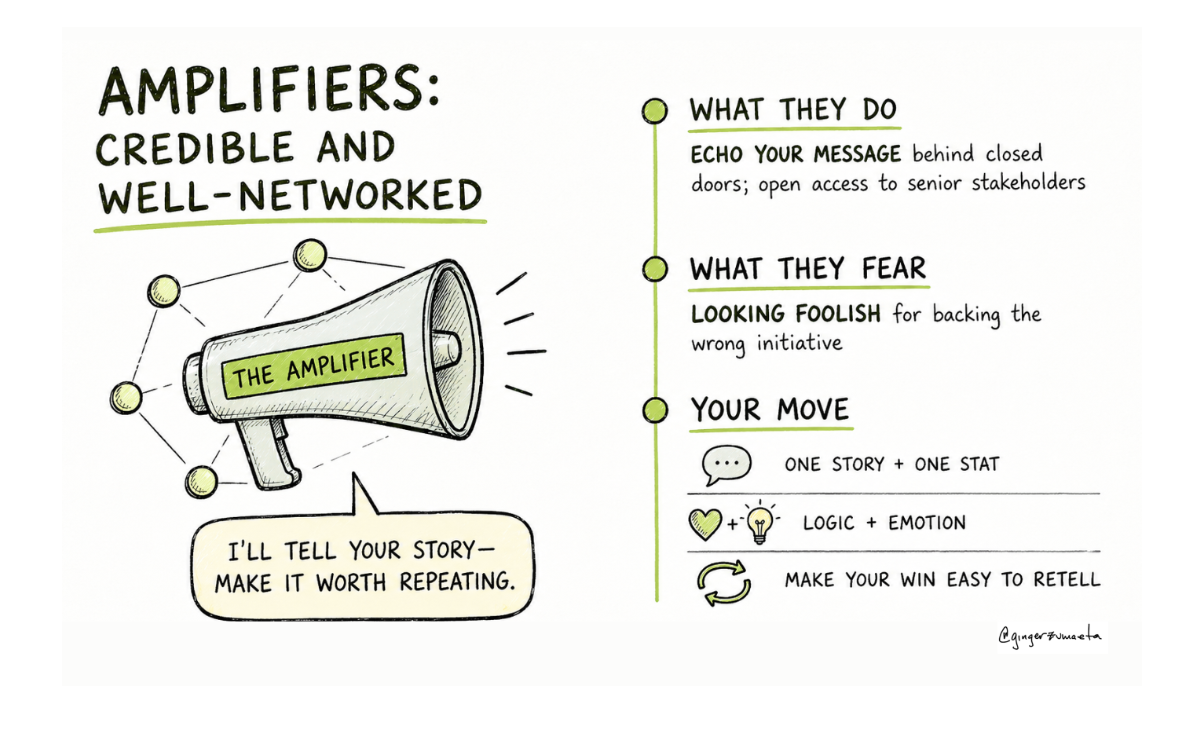
That somebody is your Amplifier — one of the 4 Hidden Roles that decide whether a message gets carried forward—or dropped. Amplifiers are credible and well-networked. But . . . repeating you costs them something.
Right now that person is working from whatever they happen to remember. Which is a problem, because the thing your Amplifier is most afraid of is looking foolish for backing you.
Not their fault. But you’re probably operating under the flawed belief that a well-informed advocate is a good advocate. After all, the research, logic, and context you gave them all pointed to an obvious decision. But then they get ninety seconds with somebody senior, and everything you handed over gets compressed into whatever they can produce under pressure.
Anything they have to summarize, they will summarize. And often, that summary is not what you would have picked.
Here's what travels:
→ One story. A real thing that happened to a real person, with a result at the end. Stories survive retelling. Frameworks do not.
→ One number. The single figure that proves it's working. Resist the dashboard. One number travels; six become "the metrics looked good."
→ One attachable artifact. A document they can point to when somebody pushes back — a one-slide narrative is usually enough. If you wouldn't attach it to an email, it isn't proof.
→ One likely objection, answered. You already know the pushback. Give your Amplifier the answer before they need it.
They added a new step to our onboarding sequence and churn has gone down 14%. Let me send you the report. Oh, and here’s what surprised us: it was a low-lift step they shipped in a day. No big UI changes.
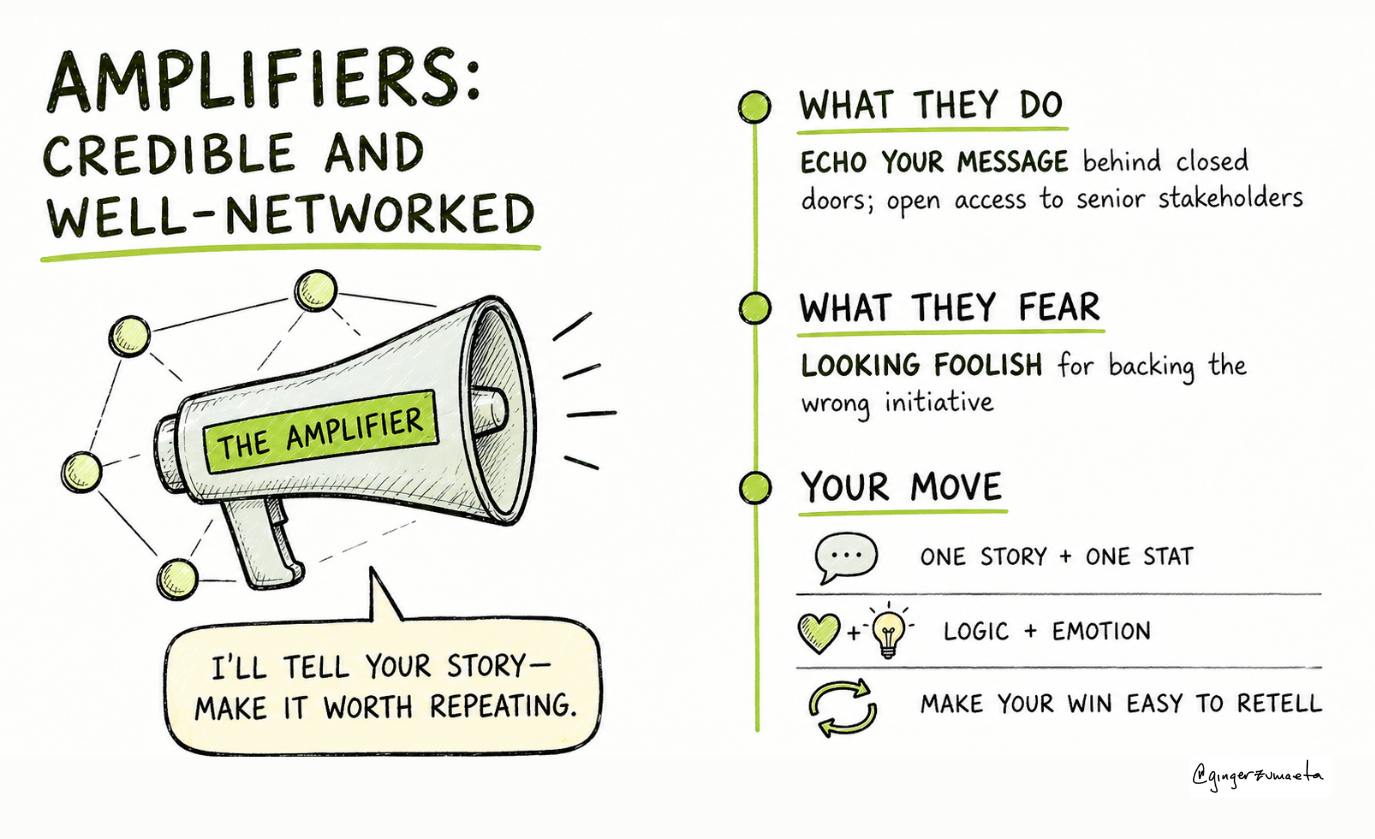
An Amplifier needs something sturdy enough to repeat and simple enough to remember. That's the entire requirement!
If the spark of your ideas keep failing to catch fire, look at the handoff. Make the message easy to carry and somebody will carry it. Start with the last person who repeated you. You don't have to recruit anybody, just find the one who already did it once and use their words.
Hey, my Strategic Influence workshop is built for this. I’ll teach your team how to plan for and manage the 4 Hidden Roles. Get in touch and I'll send you the details.


