


Hiya big thinker,
Think about last week alone. How many client calls happened? How many internal reviews? How many moments where a customer said something that would make a perfect proof point — and nobody wrote it down?
The raw material is everywhere. The system to catch it doesn't exist.
And here's what makes it worse: most companies don't even have the foundation that would make those stories usable. They're missing the one document that tells their team what to say, to whom, and why it matters.
Most companies have two of the three documents they need to communicate their value. The third one — the one that actually tells people what to say — has been the hardest to build. Until now.
Every company worth its salt has a mission, vision, and values statement. Most have brand guidelines — the logo, the colors, the typography. The visual identity.
But ask most companies, "Where's the playbook that tells your team what to say?" and you'll get a long pause.
This is the messaging architecture gap. And it's more common than you'd think — even at very large companies.
What messaging architecture actually is
Messaging architecture answers a deceptively simple set of questions:
- Who are we for?
- What do we offer them that's more valuable than the alternatives?
- How do we say that? What are the core messaging pillars, the support points, the proof points, the real examples?
That's it. Audience. Value position. Messaging pillars with evidence. Together, these form a messaging playbook — the operational layer that tells your team what to say, to whom, and why it matters.
This used to live in a thick book in the CMO's office. Expensive to produce. Rarely opened.
What's changed
Two things are now possible that weren't before.
First, your messaging playbook can live inside an AI model — with all of your audience insights, messaging pillars, proof points, and examples loaded in. Instead of a static document, it becomes a guardrail system that actively shapes output.
Second — and this is the part I'm most excited about — you can now build a story engine on top of that playbook.
The story engine
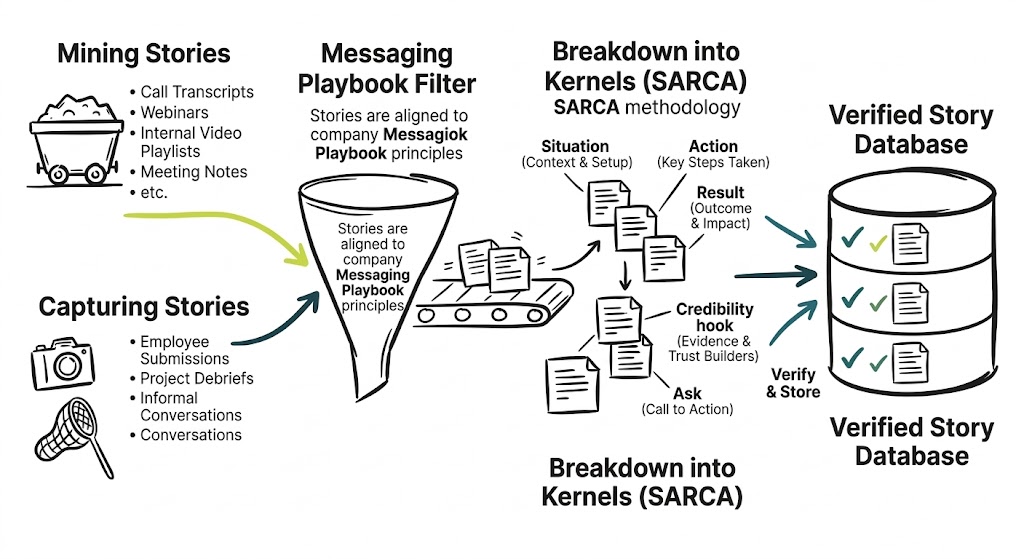
A story engine does two things: mining and capture.
Mining is going back through what already exists — meeting transcripts, webinars, conference recordings, internal docs — and using AI to surface real stories that support your messaging pillars. This replaces the old approach of running story-mining workshops, which depended on two unreliable things: your team understanding what counts as a story, and their memory of it happening.
Capture is setting up ongoing intervention points. Where do stories actually happen inside your company? Client calls. Internal reviews. Customer success conversations. Pulse surveys. You identify the triggers and the cohorts, and you build lightweight systems to grab stories as they occur — with enough detail to be useful later.
The story warehouse
Once mining and capture are running, you start building a story warehouse — a living collection of real, sourced, verified stories mapped to your messaging architecture.
Store that in a proprietary model, and now anyone in the company can query it:
- "I'm meeting with a prospect in healthcare. They care about speed to implementation. What stories should I tell?"
- "We're running a social campaign on customer success. Pull three stories that show measurable outcomes."
No tagging taxonomy to maintain. No rigid database filters to guess at. Just natural language queries against a rich, structured story bank.
Why this matters right now
The old way — manually tagging stories, coding them into structured databases, hoping you guessed the right filter categories — is increasingly inadequate.
If you have to deal with an enterprise tool like Salesforce to input a story and then be able to pull it back out, you know what I’m talking about.
Sooooo much time setting it up. So little time using it.
The companies that build this system first will have an edge. Not because the idea is obscure — it's honestly sitting right in front of us — but because most organizations move slowly. The ones that move now, even imperfectly, will compound their advantage as the tooling improves.
What you can do today
You don't need the full engine running to start. Here's what you can put in place right now:
- Map your intervention points. Where do stories happen in your organization? List every touchpoint — calls, meetings, events, support channels.
- Start capturing. Even if it's rough. Record meetings. Save transcripts. Flag moments that feel like stories. You're building raw material.
- Get your messaging foundations in order. If you don't have a messaging playbook, that's step one. The story engine needs rails to run on.
As AI capabilities progress, you'll be ready. You'll already have the beginnings of your mine. The companies that wait will be starting from zero.
This is what we're building at Motive3 right now — story engines on the rails of messaging playbooks. If you want to talk about what this could look like for your company, start a conversation.


