


.png)
Hiya brand builders!
Your AI is fast, tireless, and eager to speak for your company.
But it can't read a room. It has no idea what your company is like except for what you tell it. It operates on hearsay.
It works from the prompt.
And there’s another wrinkle: whatever your team types into that box is sitting on top of a gargantuan model trained by Anthropic, OpenAI or Google. That model has its own style. Its own preferences about sentence length. About how to open a paragraph. About which words sound professional and which ones sound too sharp.
Your prompt, or even your painstakingly detailed voice guide is but a wafer thin layer over all of that.
So a draft comes back and you think ..."eh. That's not us."
But that instinct is the entire quality control layer at most companies right now. Over 70% of marketers say off-brand copy has already gone out under their company's name. Less than 35% plan to increase what they spend on AI governance or brand oversight in the next 12 months (IAB, 2025).
Yikes.
So the model's voice keeps winning, by forfeit, in a whole lot of companies.
But think about how you'd onboard a human copywriter.
You'd sit them down first. You'd hand over your messaging architecture or your playbook. The priority messages, the voice, the words you use. You'd show them a few things you've published that actually worked, and tell them WHY they worked.
Then you'd share the constraints: how long pieces run, the words you'd never be caught using, what's off the table. And if you were great at onboarding, you'd do the one thing most people forget. You'd show them how you took a bad draft and made it good because telling someone what good looks like only gets them halfway.
That's onboarding.
Now watch what happens when that same leader points AI at the work.
They tell their team to "use AI for the first drafts" and consider the problem solved. No playbook handed over. No examples of what's worked. No guardrails, no picture of what finished looks like. Just a brand-new hire with zero context, and a team told to make it produce.
You'd never onboard a person that way. So why sign off on it for the thing that's about to write in your company's name?
AI doesn't get good on day one, and neither does the person prompting it. A copywriter gets good because someone tells them what missed. "Closer, but it's stiff." "You buried the point." "This line right here, give me more of this." That's the loop. AI runs the same loop, but only if your team has a standard to measure against.
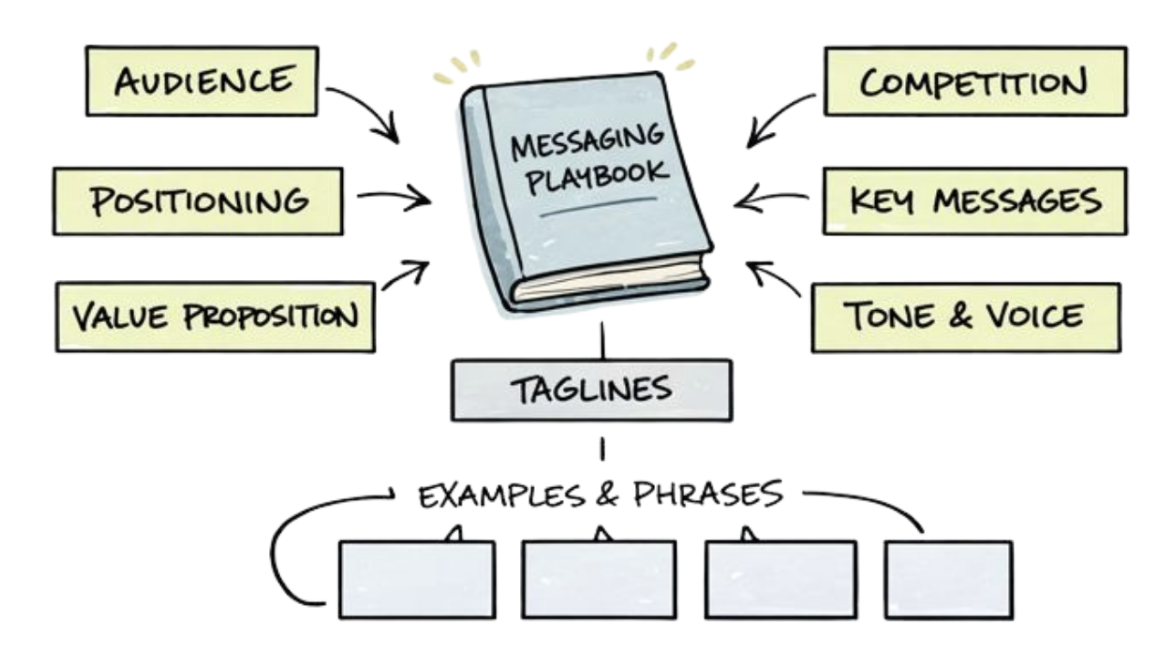
That standard is a messaging playbook. The voice. The priority messages. The good examples and the bad ones. Without those, your people are coaching toward a target no one has defined. That's just scaling guesswork.
I spent months building an AI content engine for myself. I gave it a detailed voice guide. My own messaging playbook. A custom story extraction method. Dozens of examples of how I actually write.
It works but it still doesn't sound exactly like me. It has never sat in my leadership meeting. It has never heard a client tell me, out loud, what they were really afraid of. It has data, but no pulse.
That's the honest deal. The playbook makes your strategy enforceable. You still have to bring the pulse.
Hand it your pillars. Tell it every piece of content has to ladder to at least one, and name which. Now the AI is doing something it's genuinely good at. It's holding the line on your strategy while you're producing three posts a week, a newsletter, and a podcast, and you are too tired to notice you've drifted.
Here's what the handoff looks like: (Rule of thumb: if a smart new hire would need it to do the job, the model needs it too, and unlike the hire, it will never think to ask you for it.)
The messaging playbook itself. Brand promise, messaging pillars, proof points, voice, the objections your audience actually raises. Written. Not rattling around in someone's head.
Your good work, with the reasons attached. Pull the three pieces that actually landed. Under each one, add a line about why. The structure, the opening, the argument it made, whatever it was that worked. That line is what the AI can use. The piece by itself is just a sample.
A bad draft with the edits still in it. The comments, the strikethroughs, the note that says "this section isn't landing." That's the most useful thing your team produces, and it goes in the trash every time.
This takes time. A single post can be an hour of back-and-forth. Sorry, that's the truth. But the teams that keep coaching AI, and capture how they turned bad versions into good ones, build something that compounds.
AI isn't your voice. It's your pressure-tester, your challenger, your second set of eyes. But it can only push back against a standard.
If you’re reading this and thinking “we could use an AI-ready playbook,” contact us and I’ll share how we’d approach building one with your team.


