


Hiya communicator!
The research is in: Your audience isn't judging your writing. What they’re judging is whether you (YOU, the person reading this) stand behind the writing.
In a blind test, 56% of consumers preferred AI-written copy over a professional copywriter's version. Ouch. But, when they were told the same copy was AI-generated, 52% said they felt less engaged with it (Bynder, 2024).
Same exact words. Different reaction, the moment a name got attached to the source.
That tells you something. The true AI discomfort isn't about the writing or its ‘tells’. It's about whether there's a person standing behind it, and whether that person looked at it before it went out.
We keep treating those as the same question. They're not. There's the content itself, and there's the publisher of that content.
The question the audience is really asking is whether the writing represents something you might say out in the real world.
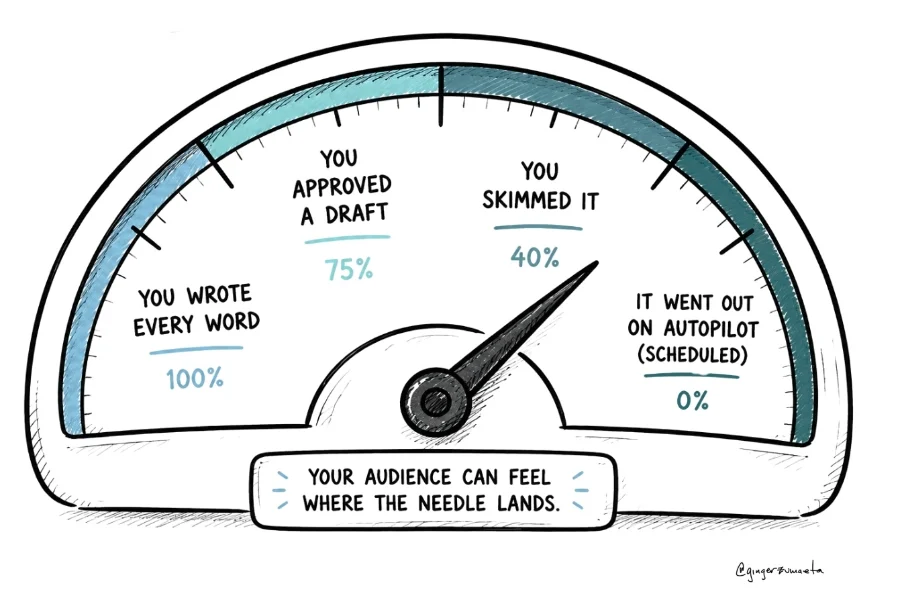
And that question sits on a spectrum. From you wrote every word yourself. To you approved a draft. To you skimmed it. To it went out on autopilot because something was scheduled.
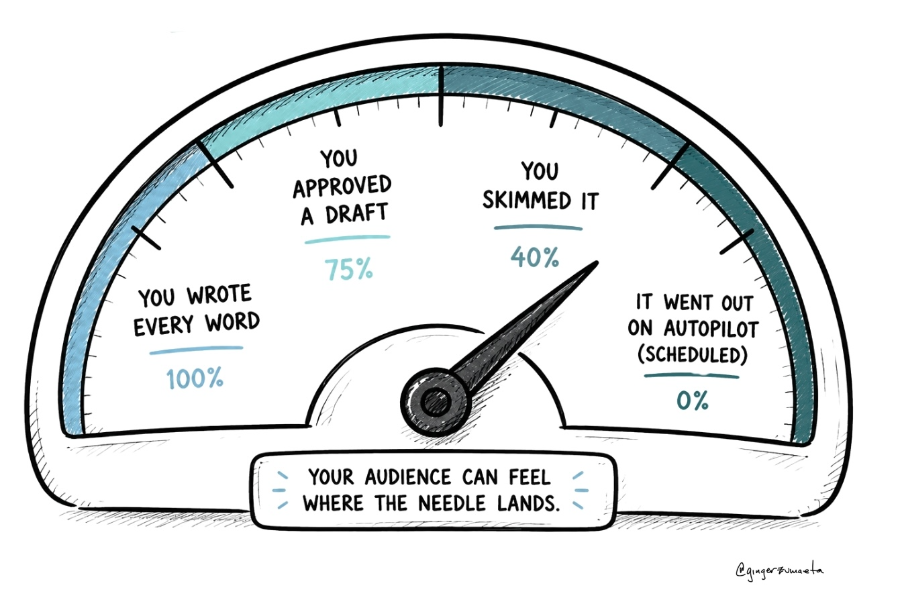
Your audience reads that spectrum whether or not they can name it.
Before AI, you didn't have to answer this. Putting your name on something was itself the signal of thinking and effort, the reputation stake, the fact that you'd risk something if it turned out wrong.
AI removed the thing under the writing that made it worth trusting.
Aristotle named this 2,400 years ago. He identified three modes of persuasion: logos, the argument; pathos, the emotional pull; and ethos, the credibility of the person making the case.
Aristotle ranked ethos highest, because without it the argument doesn't land no matter how good it is.
AI made logos cheap. Anyone can produce a competent argument now. It's gotten decent at pathos too.
What it can't do is manufacture ethos, because ethos isn't produced — it's accumulated, through consistent behavior and visible accountability, over time.
So the publisher question matters more than it used to. AI can write your message. You're still the one who sends it. And your audience is trusting the sender, not the sentence.
We’ve watched this play out already. In January 2023, CNET was caught quietly running dozens of finance articles under the byline "CNET Money Staff" — AI authorship disclosed nowhere except a tooltip you'd only notice if you hovered over the name (Washington Post). The writing itself wasn't the problem — it read fine. What broke was everything downstream of the hiding: more than half the AI-written pieces needed public corrections, and the editor-in-chief left in the fallout. The Associated Press, meanwhile, has used AI in reporting for years — disclosed, bounded, editorially supervised — without a comparable hit to its credibility. Same technology. Opposite outcome. The difference was never the prose.
Ethos shows up in specific places, not vague reassurance. It's whether you correct mistakes in public instead of quietly editing them out. Whether you name where an idea came from instead of letting it read like it sprang from nowhere. Whether the same point of view shows up in your work six months from now, not just this week.
None of that is about writing quality. It's about a track record your audience can actually check.
So before the next thing goes out under your name: would a reader be able to tell a person was in it — because the work carries your fingerprints? If you're not sure, that's not a writing problem. It's a publishing one.


