


Hiya smarty-pants!
Last week I posted on LinkedIn about knowledge decay. That's the name Harvard Business Review gave to what happens when AI output piles up inside a company and starts feeding on itself. (Holweg and Davenport, HBR, 2026)
Quick recap if you missed it.
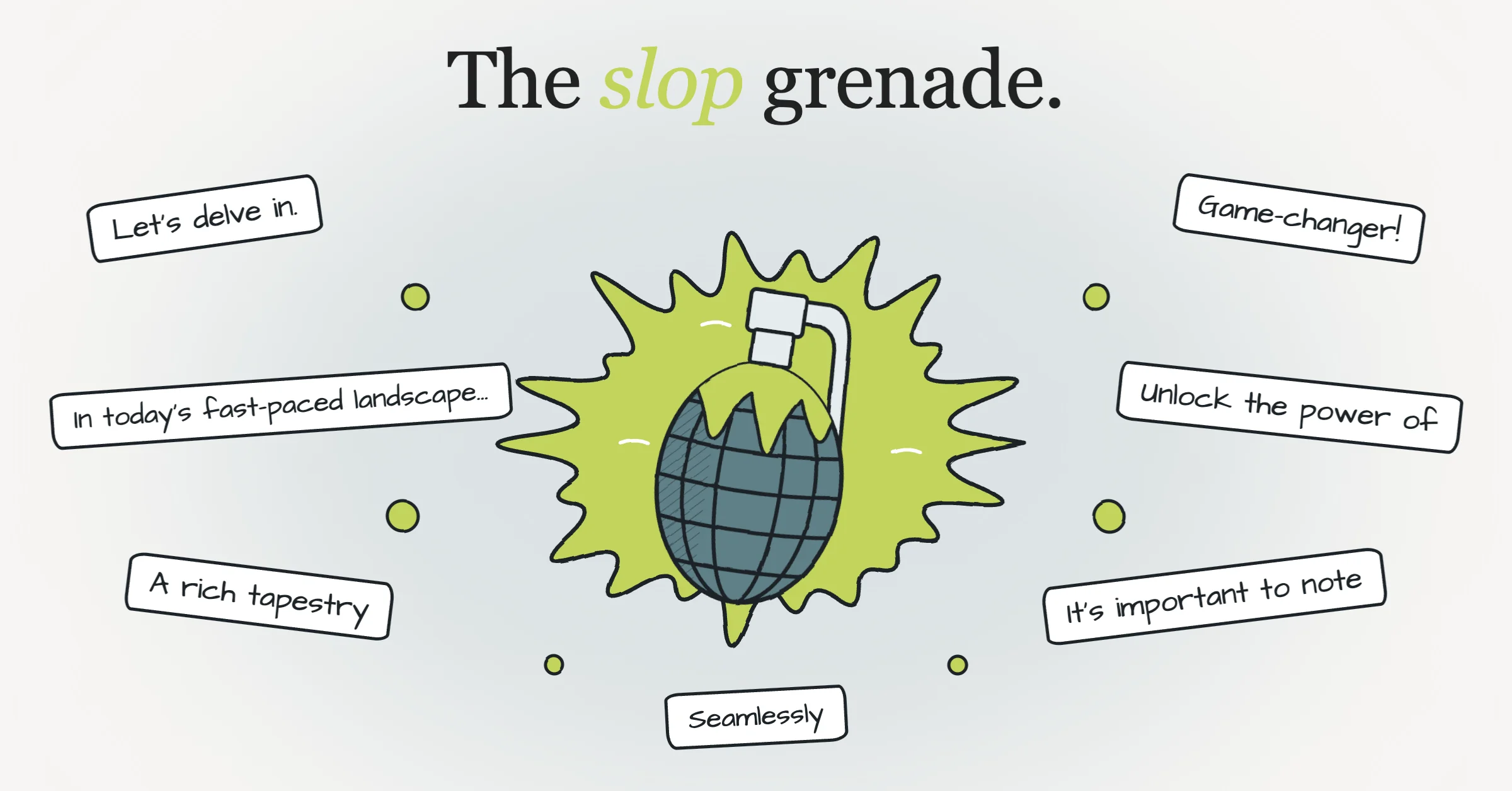
A colleague sends you a slop grenade after a "really good chat with Claude." You clock it at 13 pages!! You ask Copilot to TL;DR it. Then you use AI to turn it into a "better" doc and pass it on . . . and on and on it goes.

It's the game of Telephone, played with your strategy, your customer insight and your company's history. Each pass looks polished. Nobody can point to where it broke, because it broke in small ways, many times.
And your company makes real decisions from that pile. Who to hire. Where to invest. What to tell the board.
The post stopped there. I kept thinking about one part of it.
What goes missing first?
When AI summarizes, it keeps what sounds normal and drops what sounds unusual.
That's how these models work. They lean toward the expected. The odd, specific detail gets smoothed into something more familiar or probable (generic). And because the replacement sounds right, you don't notice anything is gone.
So think about what's unusual in your company's story. The customer who almost walked, and why she stayed after a hail-mary intervention. The product decision that looked wrong at the time, but unlocked a whole new segment. The number nobody believed was possible. You get the idea.
Those are the first details to go. They're also the ones that make you and your company different from your competitors.
After a few rounds of summaries, your company sounds like every other company in your category. And you can't prove most of what you say anymore.
That's two problems, not one:
- Your stories stop being yours.
- Your claims stop being checkable.
I know this firsthand. I have AI summarize almost all of my meetings so I can harvest stories for social. But no matter how interesting the conversation was, the summary comes out flat and lifeless by my standards. It’s all generic platitudes. It’s one of the reasons AI slop is so easy to spot.
Two questions to ask about any claim
Every leader should be able to answer two questions about any claim in the org's docs:
Where did this come from?
Who can vouch for it?
The HBR authors make a related point. Checking AI output takes time, and it can eat the time AI saved you. Their test is simple: did a human add anything, or just pass it along?
If you weren't the author, you were the mailman. (We all kinda are now.)
Where Idiograph fits
This is the problem I've been building Idiograph to solve, starting with the stories that make a company distinct.
We go back to the source material: call recordings, transcripts, interviews, notes. We pull out the specific, true stories that got lost in AI summaries. Each one stays linked to where and when it came from, and someone fact-checks it before it gets used.
What you end up with are stories that are yours and that you can stand behind — the stories that back up your brand claims in a specific and credible way. Your team can still use AI to draft. It just starts from stories that only you can tell.
One favor before you go
I'm studying this for a class I'm taking. If you work in marketing or sales, I'd love four minutes of your time: where do the customer stories your team uses actually come from? It's anonymous. I'll share what I learn in a future issue.
Take the survey (It’s literally so quick)
And if you're curious about Idiograph, take a look at Idiograph.ai.


