


Hiya ghost-whisperer,
The org chart lies to you.
It tells you who has the authority. It tells you nothing about who has the influence. And the people who do are almost never where the chart says they are.
A complex B2B decision runs through six to ten people. (Gartner.)
That's a lot of people to persuade…
You usually pitch to one of them. The other nine? They hear about your idea secondhand, from someone who was half-listening, reconstructing it from memory in a hallway. Their version is the one that gets a vote.
By the time your idea reaches the person who actually decides, it's been relayed, compressed, and reframed. Someone is explaining your work to someone who matters, in their own words, with their own POV folded in. Sometimes that's faithful. Sometimes it's a game of telephone with your budget on the line.
We treat stakeholder communication like a broadcast. Clear message + strong rationale + nice deck = approved.
Not so fast.
Everybody obsesses over the named players. Decision-makers. Champions. The ICP. But what about the people who never show up on your CRM and still decide whether you get the meeting, the reply, the yes? The validator two levels down. The blocker in legal. The engineer who mutters, "we tried this in 2021 and it was a bloodbath."
They're not hearing your pitch. They're hearing a rumor of it.
Most messaging runs on a fantasy:
You → Buyer → Decision.
In reality, it's more like:
You → Buyer → Ghost Audience → Decision.
The ghost audience never appears in the funnel. It just quietly determines the outcome from offstage.
So stop engineering for the yes in the room. Start engineering a message that survives the room.
That's the whole job: portable truths. Lines so clear and so sticky your supporters can carry them into conversations you'll never hear and not lose a thing in translation.
Can your champion repeat this to a skeptic without losing credibility? Can they defend the budget to a CFO without getting flustered?
Shape the narrative that shapes the decision.
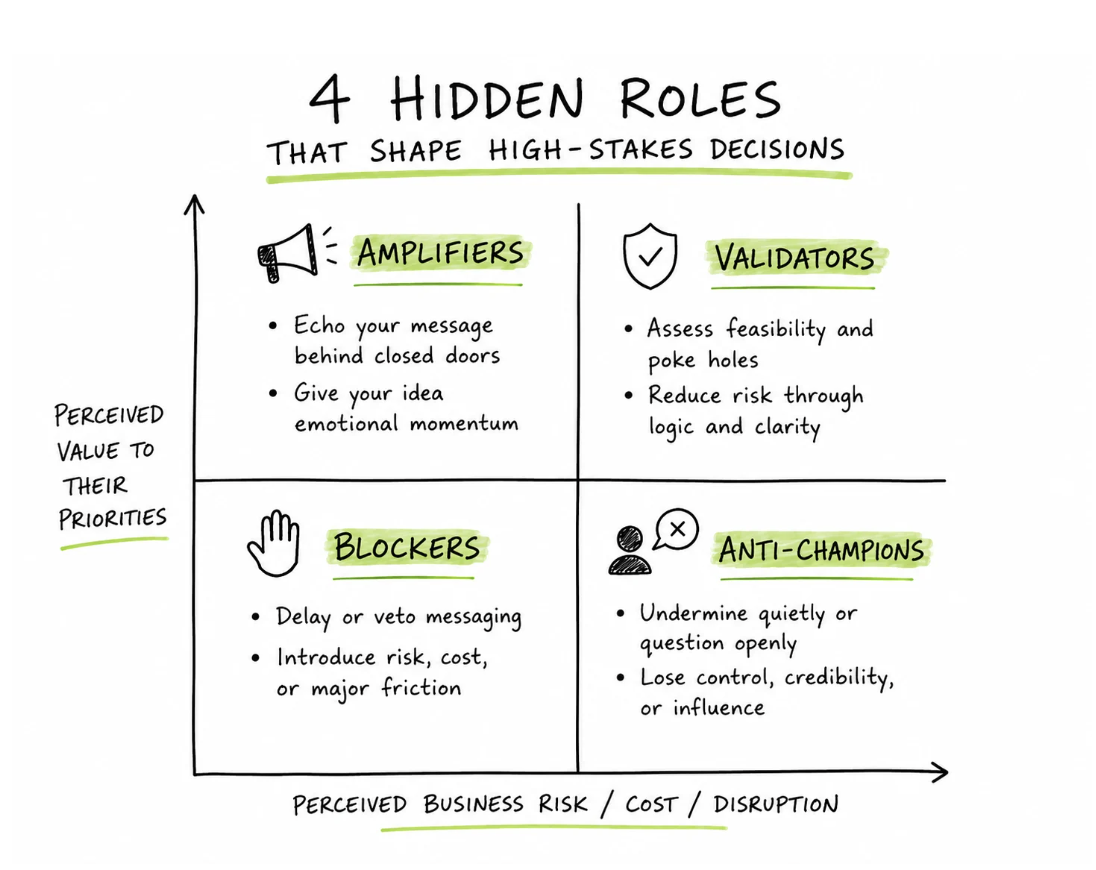
Which means you have to know who's actually in that room. Not by job title — by role. After years inside enterprise rollouts and messy stakeholder groups, I kept watching the same four ghosts show up in every high-stakes decision. Titles hide them. Behavior gives them away. I call them the 4 Hidden Roles.
Amplifiers are credible and well-networked. They'll champion you hard — but only if your idea makes them look smart when they repeat it.
Validators are logic-driven and allergic to fluff. They'll poke holes in your data just to watch it hold. When it does, they become your most durable defenders.
Blockers are wired for risk. They scan for liability and slow everything down with words like "compliance" and "process."
Anti-Champions are status-conscious. Your idea threatens their turf, so they undermine it quietly, where you can't see it. (You know exactly who I mean.)
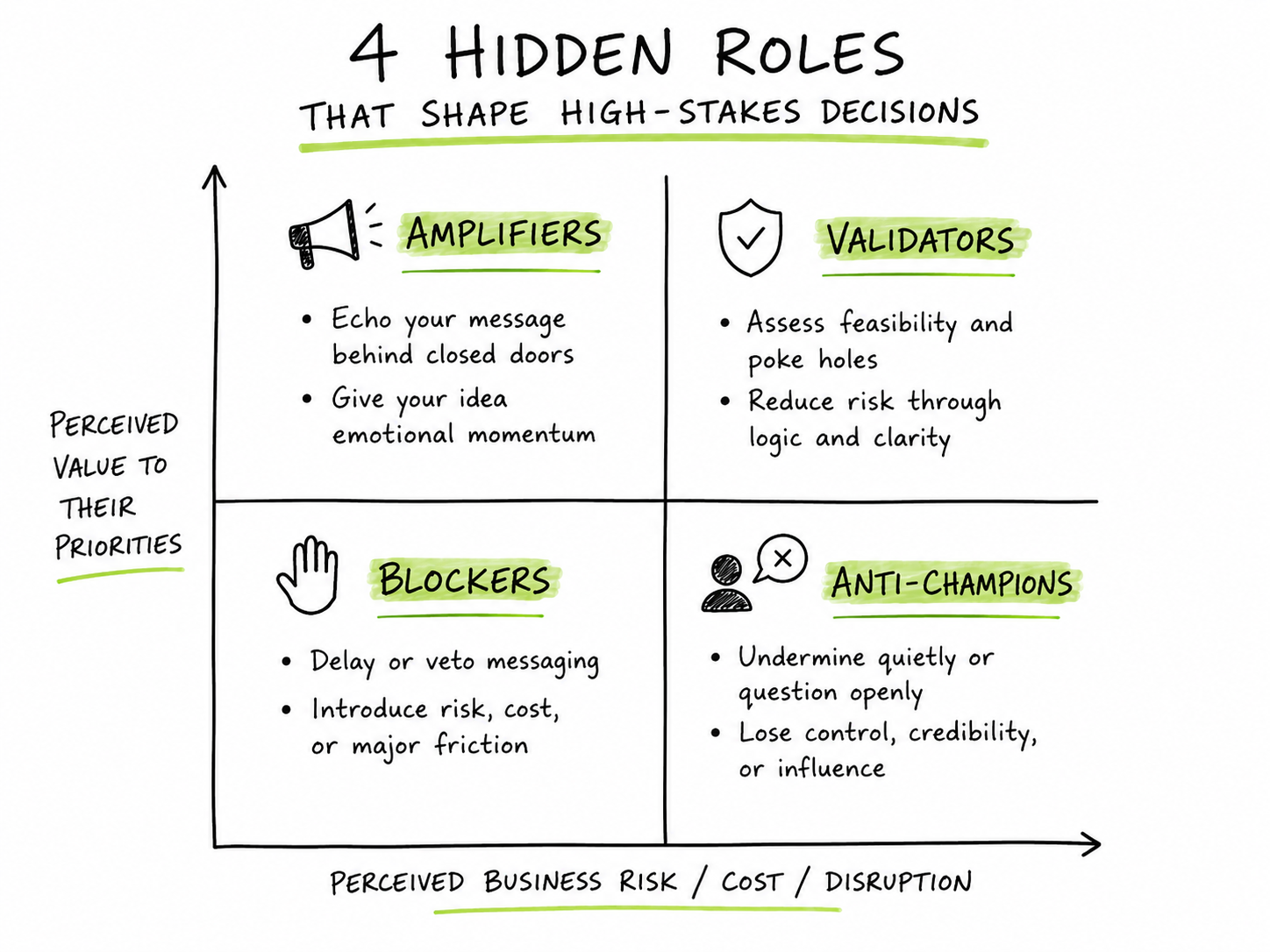
You're not pitching to a room. You're pitching through one. And every person in it plays a different role in whether your message lives past the meeting.
How the hidden roles played out at a big health care company.
I worked with a big health care provider on the rollout of a new internal broadcast channel. The case for change was airtight. HQ was thrilled. But adoption . . . stalled.
Why? Each of the eight regions had their own P&L leaders with independent agendas and established communication systems. We mapped the room and realized we weren't fighting logic. We were fighting hidden roles.
The Blockers—regional marketers—felt headquarters was stepping on their toes. The Validators—tech leads—feared integration headaches. The Amplifiers—influential marketing leads—wanted to help but lacked the concise story to sell it. The Anti-Champion—a staffer playing a role outside their typical function—didn't want their seat at the table taken away.
So what did we do?
We didn't change the plan. We changed the message for each role.
We gave Validators a guarantee to remove risk. We gave Amplifiers a "1-slide narrative" they could copy-paste to look smart in front of their teams. We brought the Anti-Champion in for a specific listening session to understand their skin in the game and ask for their critique—turning them from saboteur into consultant.
Resistance softened. The rollout stayed on track because the stakeholders felt seen.
Here's how to start before your next high-stakes meeting.
→ Forget the org chart. Map the room by role. Look at who'll actually shape the decision — including the ghosts — and label them: Amplifier, Validator, Blocker, Anti-Champion. Write the names down.
→ Build one portable line for your Amplifier. Build it from the way the deciders actually talk — the phrase that already makes the room nod. One sentence they can repeat without botching it.
→ Find your Anti-Champion and ask them to tear it apart. Before the meeting, not during it. (Yes, on purpose.) People defend what they helped build.
You can't be in every room where your idea gets decided. So arm the people who are.
This is the work I do with teams — mapping the real room, naming the hidden roles, building the lines that travel without you. If your team has the right strategy but keeps losing the internal vote, let's talk. That gap is exactly what I help solve.


