


Hiya distiller . . .
I'm building a workshop right now for a group of senior execs. The brief is essentially this: help them know how to carry a message confidently when the path forward is gray.
In other words: Can they stand in front of an executive team, navigate real ambiguity, and make a recommendation they actually believe — even when there's no clear right answer?
That's what's being evaluated at the C-suite level. It reads like a communication problem. It isn't.
A junior analyst can walk into a room right now and deliver something that looks like it came out of McKinsey. Formatted, sourced, the whole nine. And it's probably pretty good.
That used to be impossible. The signal is gone now — the output no longer indicates who did the thinking.
In fact, the output looks so good that folks are skimming it, and then passing it along as a ‘deep dive.’
Skimming!!
Thinking damn this looks really good — and then forwarding the entire thread with a note that says "here's my thinking on this, take a look."
That is not your thinking. And yes, I've caught myself doing a version of this too.
You get a 20-page output so well-structured and so thorough that your brain just accepts it. You skim past the 5% that felt a little off because going back means rethinking the whole document. And that 5% is exactly where someone's going to push. That's the 'uncanny' bit.
That tell is the thread that unravels the whole thing.
The new proof isn't what you produced. It's whether you can distill it.
Distillation: the ability to compress everything you know into a position you believe in your core and can defend under pressure. Until you've done that, you haven't crossed the finish line.
AI can summarize. It can give you the bottom line. It can make the case for multiple positions simultaneously. What it can't do is weigh the tradeoffs against your actual situation — your team, the conversation that happened last Tuesday that changed everything. It gives you the most statistically probable answer . . . not a lived one.
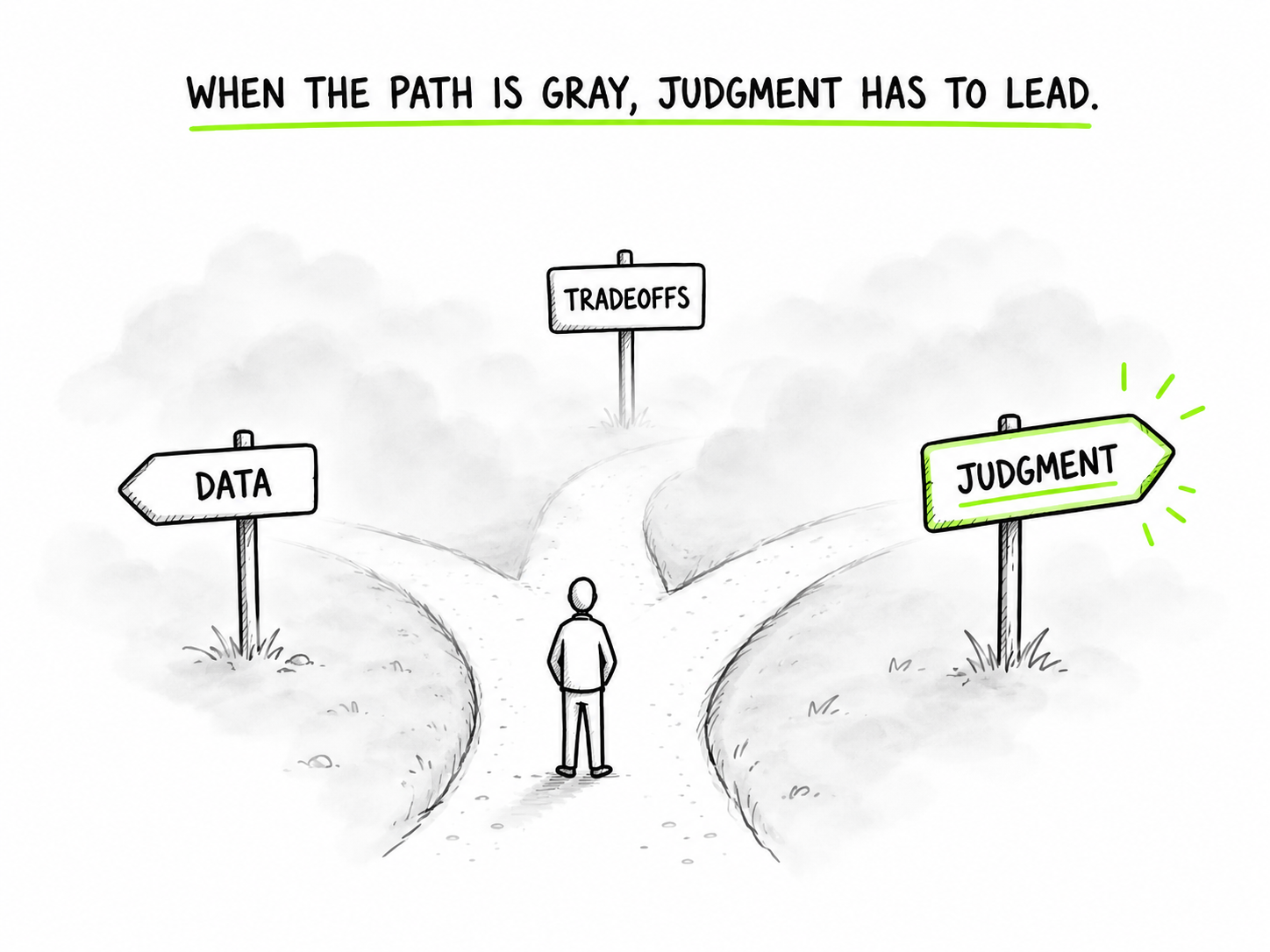
The leaders I'm working with are being evaluated on exactly this. Not output quality. Judgment. And specifically, the kind of judgment that leads to decisions. They're expected to hold a position in the gray areas, where reasonable people disagree and the data doesn't settle it.
Judgment is the one thing you should not outsource to a prompt.
Credibility now shows up in real time.
Jennifer Logg and colleagues at Harvard Business School documented this in 2019. They called it 'algorithm appreciation' — people prefer algorithmic recommendations over human judgment. The machine processed more data. Why wouldn't you trust it?
But it has its limits. Logg found algorithm appreciation wanes exactly where it matters most: high-stakes, judgment-heavy decisions. Medical diagnoses. Hiring calls. Strategic direction.
When it counts, people still want a human who can see their specific situation, not a model running probabilities. (Go humans!)
Your audience knows this. The bar they're holding you to has changed, and most leaders haven't noticed.
Your credentials aren't doing the work they used to. Your tenure isn't doing the work it used to. The audience has been getting clean, confident answers from machines all day. When you walk in and waffle, or reach for jargon to buy yourself time — they feel it. Instantly. They're fact-checking you and getting a second opinion from the AI in real time.
Here’s the antidote: Say less. Mean more.
Let the room feel the weight of what you've actually lived through and thought through.
A beautiful report will get you into the room. It will not save you once you're there.
Before you deliver anything, run this gut check.
→ What message am I delivering? Strip it to one sentence. If you can't get there, you're not ready.
→ Why do I believe this? Not why does the document support it — why do you believe it. If the honest answer is "because the output was convincing," go back and wrestle with it.
→ What am I most likely to get pushed on? Name the weakest point. Because someone else will find it. (AI can actually help you here.)
AI made the output easy. It made the thinking non-negotiable.
One more thing
Use AI. Use it constantly. I do, every day. But don't let it hollow out the one thing that made you credible in the first place — the ability to stand in a room, own a point of view, and hold it under pressure.
Clarity of thinking has always been the scarce resource.
If you're chewing on this too — or if you've got people on your team who need to learn how to hold a position under pressure before it matters — lemme know. I’ve got a workshop for that.


