


Are your stakeholder conversations landing just a little more defensively than you expect, even when you're being clear and calm? If so, here's what's actually going on.
Let's say you're raising a concern or suggesting a shift. The idea is solid. The logic holds. Nothing about your delivery feels confrontational.
But you’re bracing for the room to get defensive anyway.
Even though . . . you’re not blaming anyone; you aren’t calling out mistakes. You’re simply naming something that needs attention.
Here's the diagnosis: the message probably isn’t leaving the other person any room. So it puts them in the position of feeling exposed . . . which will make them go into protection mode versus engagement mode.
This is the unseen trigger behind most stakeholder resistance.
The pattern I see constantly.
Leaders underestimate how quickly people shift into self-protection. It's not about ego or thin skin. The moment your message touches something they're responsible for, it becomes easy to interpret as "You're pointing at a flaw in my work"—even when that's nowhere in what you actually said.
You might assume resistance means the idea is wrong or the timing is bad. Or that it will make change more challenging. But most of the time, resistance is just an emotional signal that the message didn't leave room for collaboration.
Your message is technically correct, but emotionally unworkable.
The shift.
Influence depends on how safe people feel in the conversation. Stakeholder messaging isn't only about clarity; it's about delivering direction in a way that keeps people participating instead of protecting.
Real influence starts with a harder question: How does this message feel to the person receiving it?
When the emotional read on their end is pressure, blame, or spotlight, the wheels of resistance are already turning. When the message signals partnership, people stay engaged.
You don't need warmer language or softer edges. You need to make sure your delivery leaves room for people to participate rather than defend.
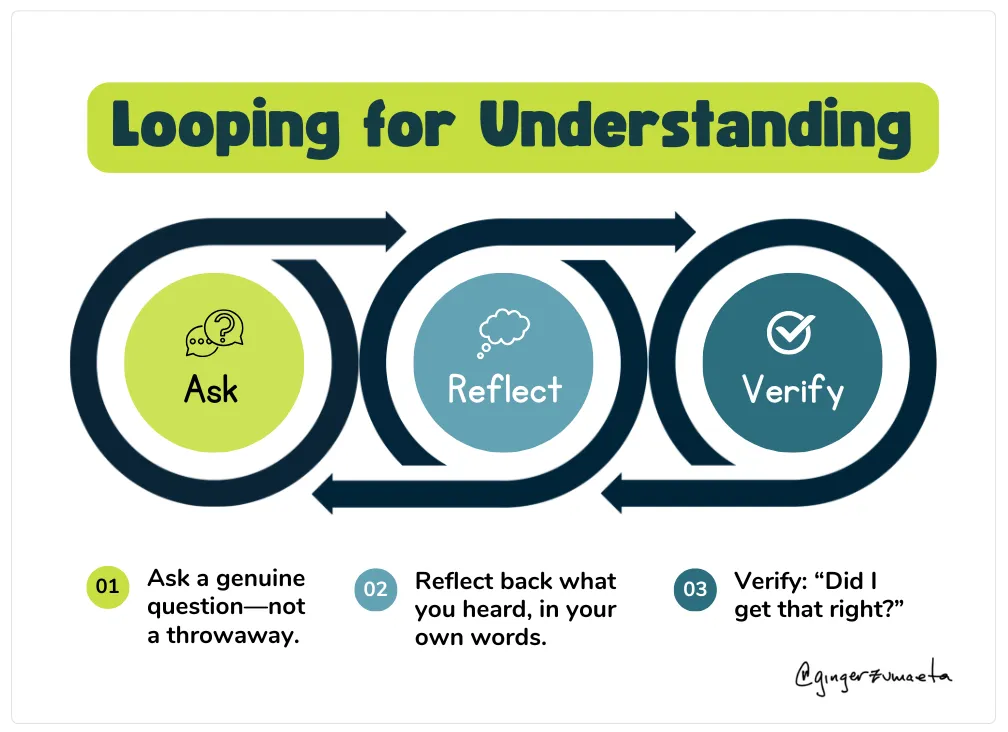
The tool: Looping for Understanding.
This is a technique I use with clients when the stakes are high and the room is tight. It comes from hostage negotiation research, and it works because it forces you to create space before you push.
Three moves:
- Ask a genuine question—not a throwaway. Something that signals you want to understand their reality before you deliver yours.
- Reflect back what you heard, in your own words. This isn't parroting. It's proving you actually listened.
- Verify with a simple: "Did I get that right?"
That's it. Ask, Reflect, Verify.
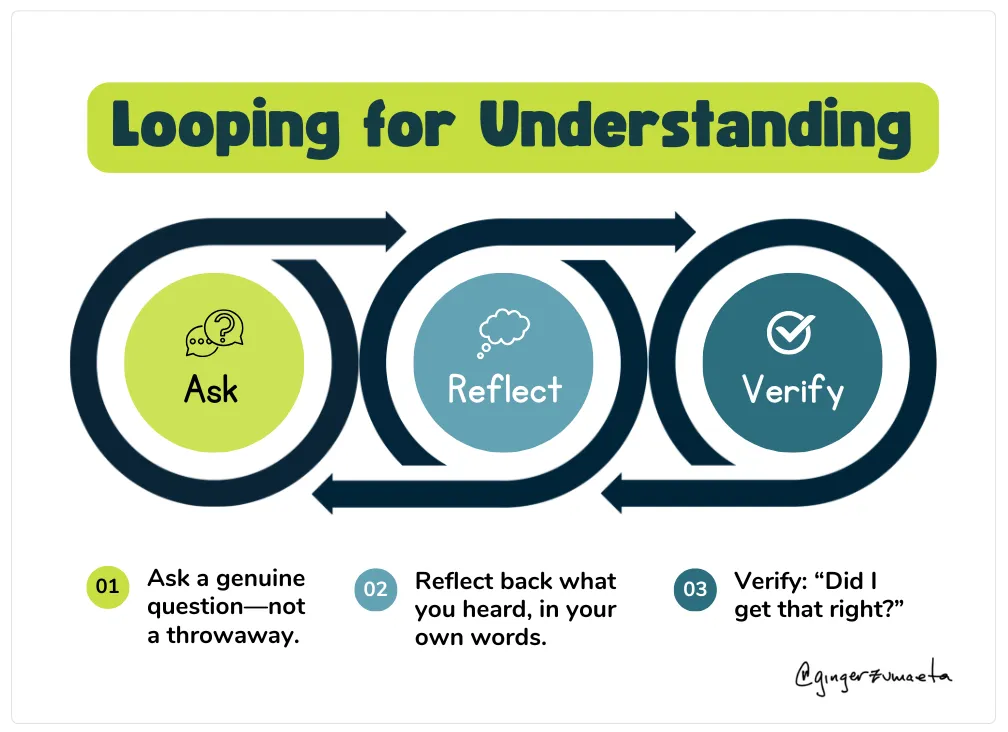
What this does is lower the temperature before you introduce tension. By the time you raise the concern or recommend the shift, they've already felt heard. The ground is stable. They're far less likely to interpret your message as an attack because you've already demonstrated partnership.
A quick story.
I worked with a marketing leader who kept hitting walls with the engineering team. Every time he flagged a timeline risk, the conversation devolved into defensiveness and finger-pointing. His message was fact-based. His delivery was calm. But the other leader heard blame every single time.
We rebuilt his approach using Looping for Understanding. Before raising the risk, he started with a genuine question: "What's your read on where we are?" Then he reflected back what he heard. Then he verified. Only after that did he share his concern.
The next conversation? No defensiveness. They solved the problem together on a quick call. Same message. Different sequence. Completely different outcome.
Here’s your move.
Pick a stakeholder conversation you have coming up—one where defensiveness is likely. Before you deliver your point, run the loop:
Ask a real question about their perspective.
Reflect back what you heard.
Verify you got it right.
Then deliver your message.
You'll find that conversations that used to stall suddenly move. The dynamic changes because the way it lands finally supports the outcome you're trying to drive.
Stakeholders don't resist clarity. They resist feeling cornered. Remove that pressure point, and influence follows.
One more thing.
Clear messaging is only one part of the job. The real impact comes from how you communicate it when the stakes rise.
Pressure reshapes how people hear you. Every room brings its own expectations, assumptions, and priorities. Leading through that requires skill you build over time, not a script you repeat.
That's the work inside my Narrative Coaching. We dig into the signals, the pacing, the framing, and the moments where influence is either gained or lost—so your communication holds steady even when the conversation gets tight.
If the rooms you lead are fast-moving, nuanced, or politically complex, hit reply. I'll help you identify the pressure points in your delivery and the moves that keep influence intact. Learn more.


