


Hiya humans.
So, things have changed in the last 18 months, eh. They're better-ish.
Have you noticed how profesh' everything is? Company messaging has never been more polished.
Suddenly everyone's stuff is perfect. And that's exactly the problem.
Except Ram Trucks. That’s a whole different and hilarious story.
Audiences have never been more suspicious. And in many cases, with good reason.
A study by Bynder tested this directly. They showed the same copy to two groups — one was told it was written by a professional, the other group was told it was AI-generated. 56% of people with a preference picked the AI version. But when they knew it was AI, 52% felt less engaged.
Same words. Different reaction.
What's up with that?
It means . . . that part of the credibility has to do with the communicator, not the communication itself.
Turns out you can't write your way out of a credibility problem.
What audiences are actually looking for
When a reader is in evaluation mode — comparing vendors, vetting a speaker, deciding whether to trust a claim — they're not looking for better prose. They're looking for a reason to believe the claim is real.
I've started calling this provenance. Not transparency or even authenticity — those words have too much baggage. Provenance: can this claim be traced back to something that actually happened?
Provenance is mostly used in the art world. It's a way of tracing the origin or the history of ownership of the work. And the reason it matters is because of forgers.
Provenance asks, how do we know this is really the original?
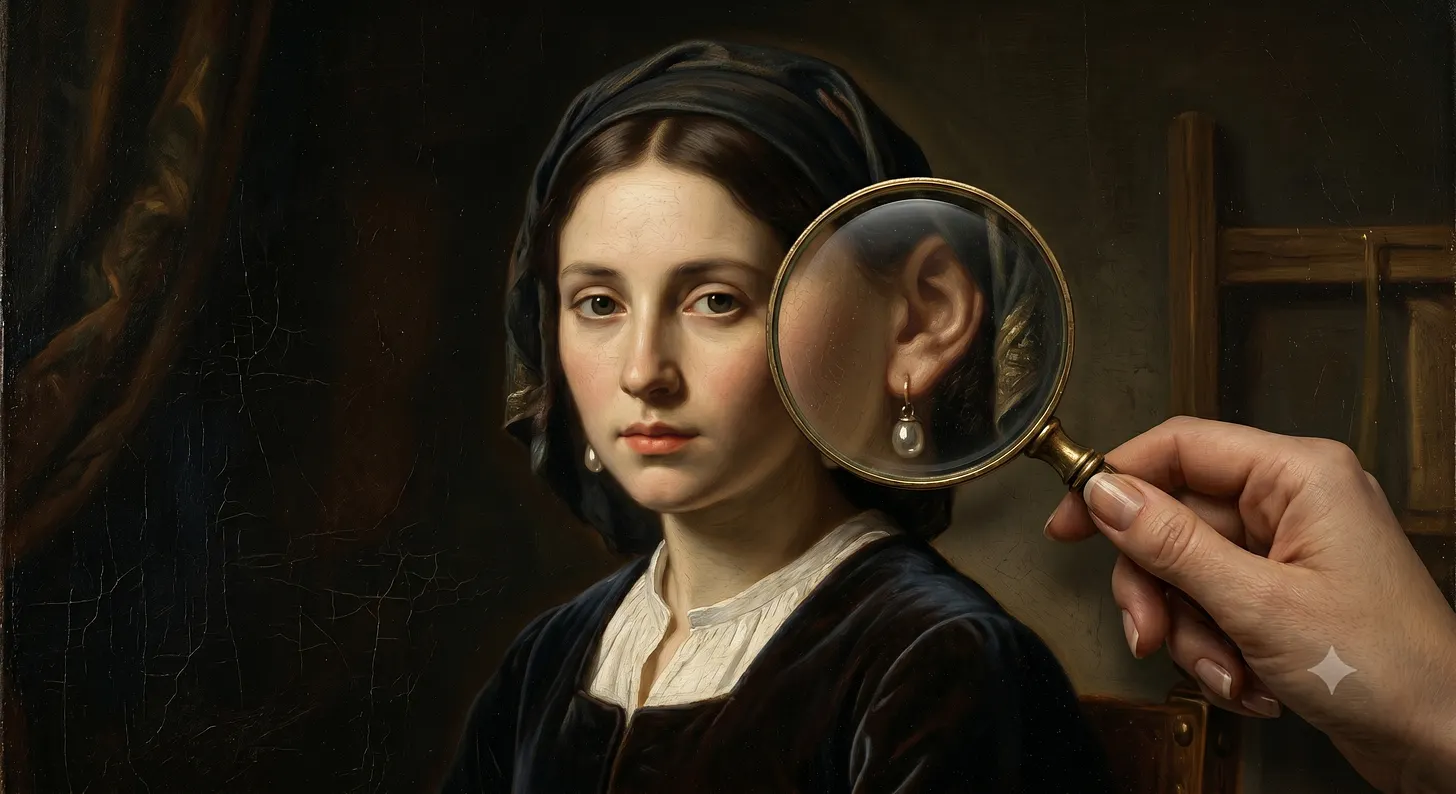
There's a 19th-century art detective named Giovanni Morelli who cracked the forgery problem. He figured out that to spot an original from a fraud, don't look at the prominent features — the face, the hands. A skilled forger studies exactly those parts and imitates them carefully.
Instead, look at the earlobes. Or the way a background figure's toes curl. He learned to look at the marks the master made without thinking.
His insight: genuine individuality reveals itself where conscious styling fails. The unforgeable truth lives in the unguarded moment — the things done unconsciously.
Now bring it forward to today. An AI can generate a polished case study. It can produce specific-sounding metrics, realistic setbacks, and spot-on insider jargon. What it can't do on its own is produce a claim that traces back to something that actually happened.
Audiences are starting to sense the difference. As statements — claims — increasingly have no source of origin in reality, readers stop asking what it says and start asking what it's hiding.
The advantage you already have
Many companies are simultaneously story-rich (internally) and story-poor (externally). Years of real work but little to none of it surfaced as proof.
But it exists. I call it dark proof — evidence produced as a byproduct of actual work that never makes it past the event where it happened. It's the call notes, the meeting transcripts, the Zoom call debrief session. It's all that raw evidence of execution.
It's dark because no one thought to treat it as a strategic asset. It was just work.
This is the earlobe. It's the part no one was deliberate enough to style — which is exactly what makes it credible.
We create this stuff ourselves unconsciously all the time, but we rarely take the time to even notice it. Your calendar for example. Take a peek at it and then think about how much work it represents, all the conversations it indicates, all the work that happened outside the time you were in meetings.
My theory is that the organizations that will prevail through this shift won't be the ones with better content strategies — the margin between good enough and great is teeny now. They'll be the ones that figure out how to surface the credibility of the teller of the stories they tell. They'll be the ones that share what they've already done, and use it as the foundation for every claim they make going forward.
They'll be the ones that expose the provenance of their stories.
The reframe
The problem was never a shortage of evidence. It’s really been cost and inconvenience of retrieval.
AI deployed as a writing machine is solving the wrong problem. More polished content, faster, with no provenance behind it is really just creating more noise.
The move most organizations haven't made: use AI as a mining engine instead. Turn it inward, onto your own operational archive. Let it find the specific, verifiable moments that no competitor can replicate, because they weren't there.
What comes out isn't generated. It's excavated.
And that difference is exactly what audiences are now scanning for.
They want proof.


