


Hiya trust agent,
Organizations are watching trust in their institutions collapse in real time.
Net trust in global companies is approaching zero. (GlobeScan, 2026)
Even science and NGOs — the "purpose-driven" institutions — are declining. Leaders at Davos named trust erosion as one of the biggest risks to global progress. It seems like nobody knows how to stop it.
All this despite better tools! Better data! Better everything! (Hello AI-generated content.) Companies are producing more sophisticated brand communication than at any point in history and people are connecting with it less than they ever have.
You can feel it as a consumer. I can feel it. You open an email and you know in about two seconds whether it got AI-generated and someone hit approve without really reading it. You land on a website and something feels too perfect.
Everything has this uncanny aura of non-specificity. It sounds right. It says nothing real.
Companies need to stop telling stories and start telling histories.
Consumers are savvy and skeptical . . . and they can smell insincere or inconsistent messaging from a mile away. When they get even a tiny whiff of it they hit the big ol' pause button. They start researching. Start comparing. Start asking around about you.
Ugh, that's deadly for sales. Because once someone goes from I'm interested to I’m fact-checking . . . good luck getting that momentum back.
The more advanced we get, the more trust matters.
Trust is the ultimate currency in business. It always has been. And it's becoming increasingly scarce at the exact moment we have more capability than we know what to do with.
So how do you actually earn trust right now? Same way it's always been earned.
You tell a story. But not any story. You tell a story that will survive the skepticism. In other words. A history.
Someone telling you what actually happened — the problem they solved, the call they made under pressure, the approach they took that changed everything for a client — with enough specificity that you believe they were actually there. That's what makes a brand feel like there's truth behind it . . . and it's the thing that's getting buried right now under all the output.
Data tells you someone is competent. A history tells you someone has been there. We keep treating those like they're interchangeable. They are so, so different.
Data satisfies the logical brain. But trust satisfies the gut. Trust is felt. And despite how much we try to beat our instincts into logical submission . . . feelings are what drive decisions. That’s science. Go look it up.
Emotion sells. Logic justifies.
History — aka verifiable lived experience — is the last unfakeable asset.
(Yeah, yeah. I’m setting fake news aside here. No time for that).
Most organizations that have been around for more than a few years are sitting on a mountain of trust. The client call where someone finally said the real problem out loud and the company rose to the challenge. Or a product launch that went sideways . . . but the lesson completely rewired how the team operates now. Or a customer who threatened to cancel but was saved by a CSR with the power to make things right.
All of that is trust currency. Real, spendable, deployable trust currency.
And it's just . . . sitting there.
It’s a structural problem, but organizations keep treating it like a communications problem. They kick it over to marketing or comms and say ‘Fix the messaging, run a campaign, issue a statement’.
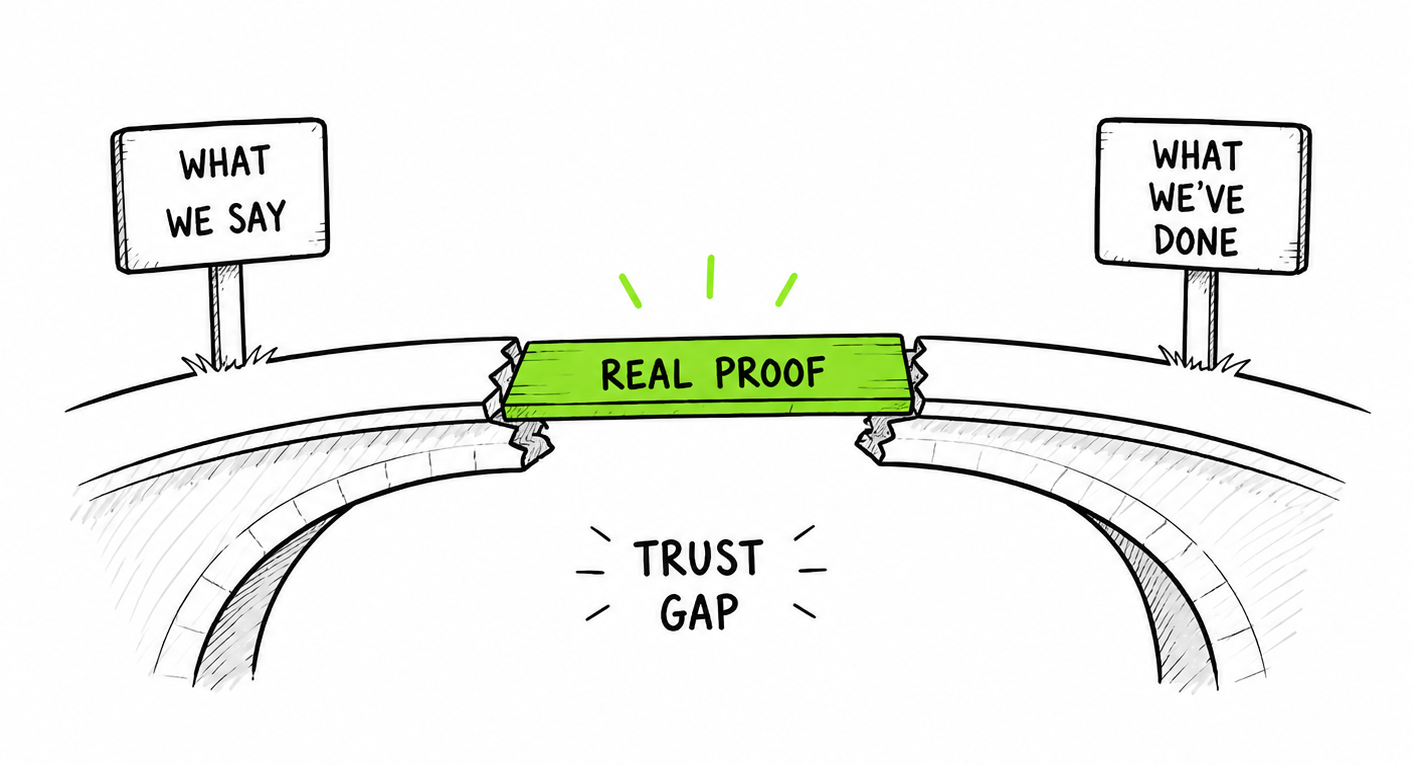
The data shows trust is declining even where institutions say the right things. But the gap between stated purpose and observable behavior is the actual driver.
The challenge is there’s no good way to harvest all this goodness. Nobody wrote it down. Nobody thought of it as a strategic asset. It lives in the heads of the people who were on that call and by the next meeting it's already fading.
I was chatting with a colleague at UT just last week and he was lamenting about a case study that his team is putting together. But it seems to be stuck in molasses. It’s taking forever to finish.
I know this particular brand of stuckness. Case studies are hard because you have to recreate the sequence of events that led to the conclusion. In the debrief, you always end up saying ‘we should have captured that when it was fresh.’
Case studies fail when they feel like an autopsy. We try to work backwards to find the 'Eureka!' moment, but by then the sweat and the surprise have evaporated.
People aren't looking for a polished white paper; they’re looking for proof that a human was home when the lightbulb went off. There’s something about capturing breakthroughs as they happen that give them an immediacy that is palpable and visceral — in other words, felt.
But good news, folks. The proof already exists inside your organization. You just have to start capturing it.
Consistency still matters — I'll die on that hill. But what you're being consistent about has to shift. Consistent polished output is just . . . wallpaper at this point. Consistent human proof — real stories, deployed deliberately, across every touchpoint — that compounds.
Think of it like deposits in a trust bank that pays compounding interest. Every real story you put out there makes the next one land harder.
Here's how to start.
→ Record a handful of your calls. Client calls. Internal calls. Upload them to your AI and ask it to find the moments — where someone named the actual problem, where the energy shifted, where a real story landed.
→ Then start making deposits. Put one real story into one piece of content this week. Just one email or one post where someone's actual experience makes it in. Then do it again next week. That's how the trust bank works. It compounds. But only if you're putting something real into it. (Kinda like I did with my convo about case studies.)
AI can do a lot of things for you right now. But trust? - that’s earned. It’s not prompted.
One more thing.
I'm helping companies build this right now — the systems to mine their real stories and put them to work as trust currency (and I'm kind of obsessed with it). If any of this hit a nerve and you want to start building this for your organization, let's talk.


