


Happy New Year!
The first few weeks of the year are full of quiet assumptions.
THIS WILL BE THE YEAR!
New priorities get announced. Roadmaps reset. Performance expectations subtly reframe.
There’s an unspoken belief that this is the stretch where effort starts to compound.
Then—
Someone with objectively weaker work gets the opportunity. The promotion. The budget. The seat at the table.
That moment creates a special kind of confusion for high-competence leaders. You’re doing the work. Delivering results. Solving real problems. And yet… momentum stalls.
This is where a lot of smart people draw the wrong conclusion: “If I just keep my head down and execute, it’ll sort itself out.”
It rarely does.
Because what’s at play isn’t effort or ethics. It’s a quiet, structural trap that rewards narrative—not just merit.
The mistake: Falling for the meritocracy trap
We like to imagine a pure system: Do good work. Get rewarded. Nice. Clean. Fair.
When I worked for NBC in the years it was under GE—in the Jack Welch years (yep, I’m that old) . . . meritocracy was our religion. And it worked, kinda . . .
But not so much anymore.
Today it’s a little more than a fantasy.
Because work is less observable, more cross-functional, less directly attributable.
When outcomes aren’t directly attributable, interpretation replaces merit measurement.
And guess what . . . interpretation favors narrative.
Most organizations are not meritocracies. They are interpretive economies.
→ Value is created by execution.
→ Opportunity is allocated by belief.
And belief is shaped through:
- Story
- Sponsorship
- Timing
- Framing
- Trust
This doesn’t mean merit doesn’t matter.
It means merit is table stakes, not the differentiator.
In most organizations, great work whispers unless you give it a microphone. High-competence leaders often believe their output speaks for itself. They view "visibility" as vanity or politicking.
But while you are waiting for your work to be noticed, someone else is shaping the narrative.
Research on career advancement is clear: Merit is only part of the equation. The rest is about how—and to whom—that merit is communicated. If you leave this to chance, you leave your career to chance.
The shift: Visibility as asset management
You need to accept that in every organization, there are two parallel realities:
- The work you do.
- The story people tell about the work you do.
These two things are not the same.
Visibility runs on an unspoken operating system:
- Narrative: The story about your work that circulates when you’re not in the room.
- Sponsorship: Senior leaders willing to spend political capital on you.
- Political Skill: The judgment to get the right message to the right person.
Stop looking at visibility as "bragging." Start looking at it as Asset Management. You are ensuring the organization knows exactly what assets (you and your team) are available to solve their biggest problems.
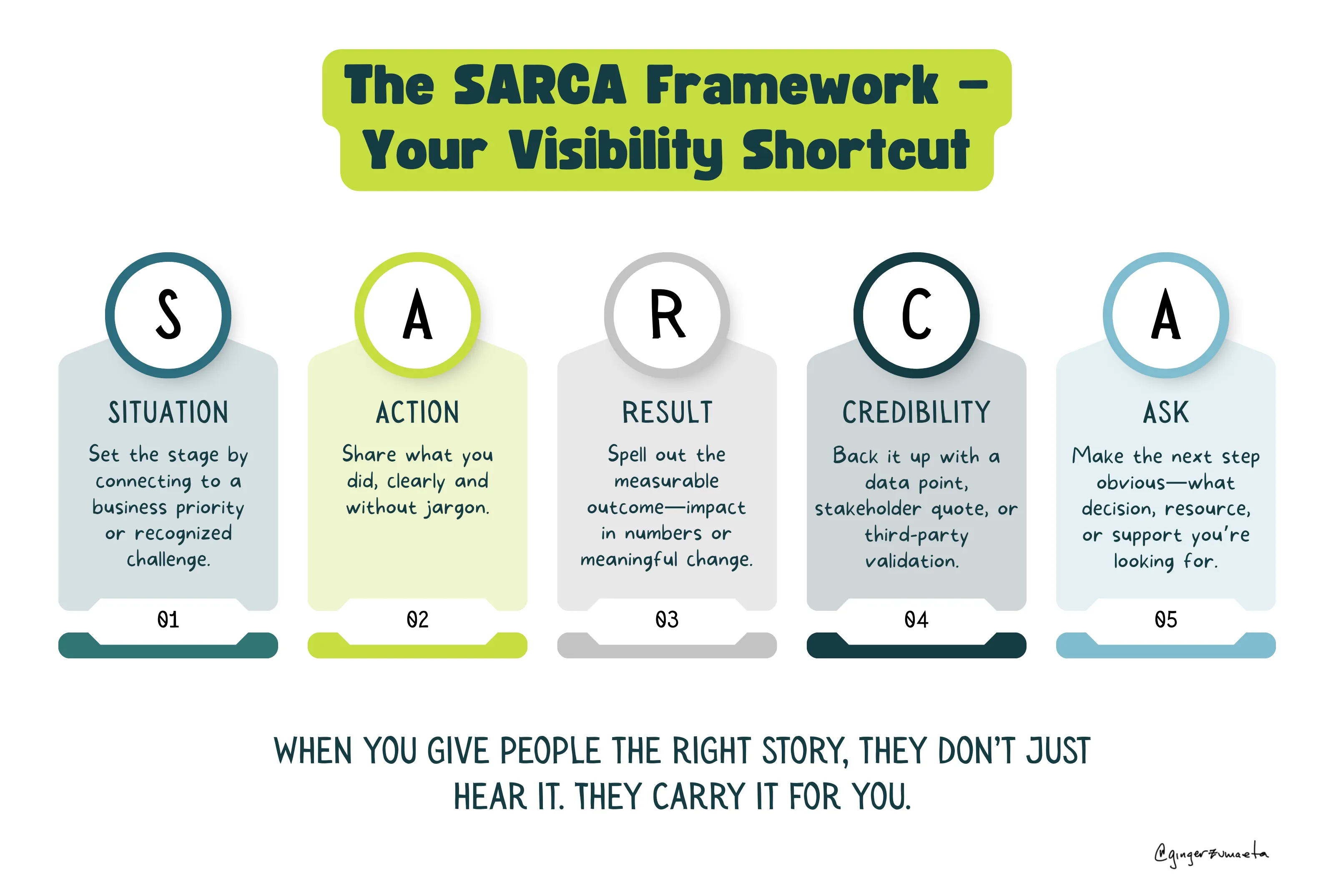
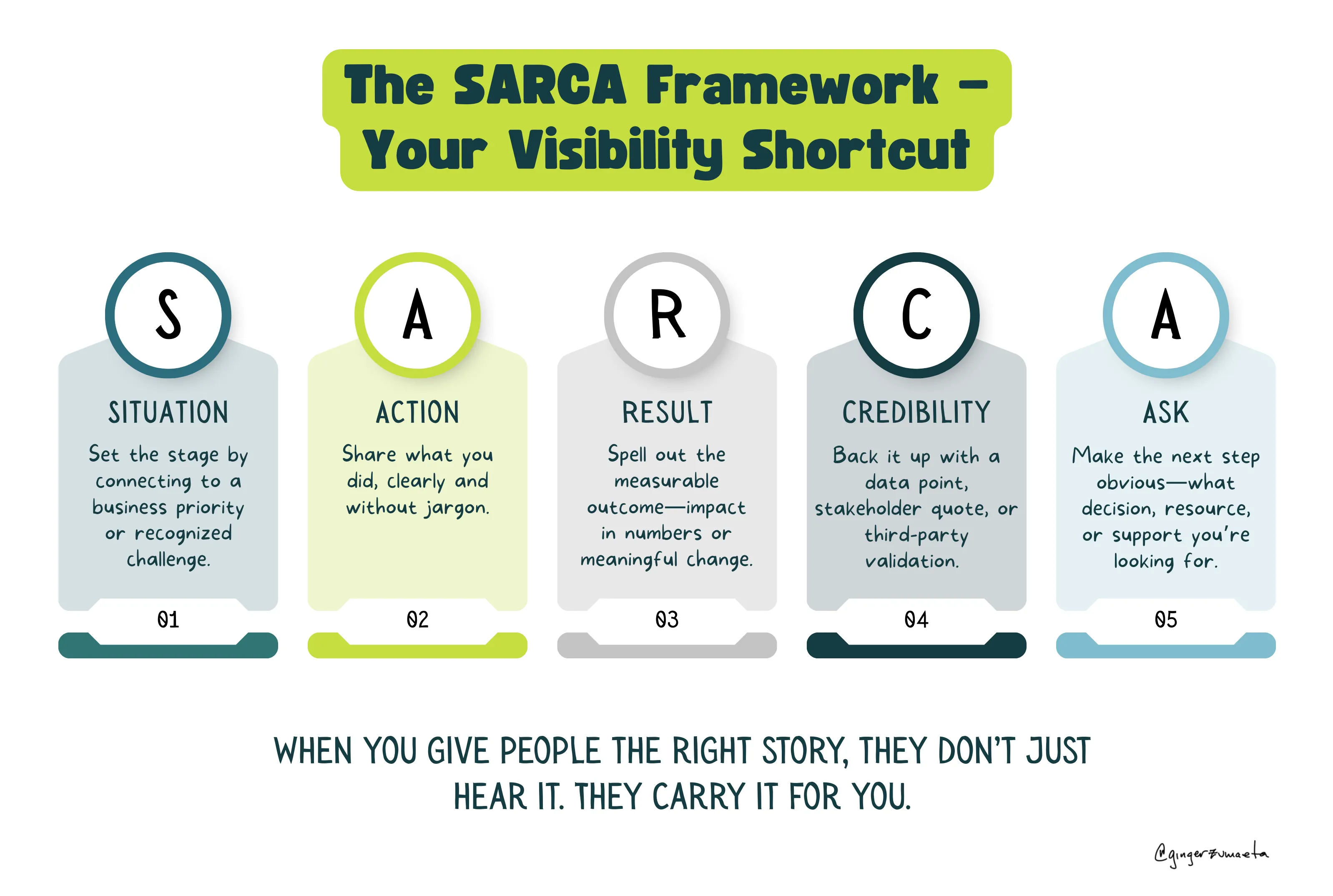
The Tool: The SARCA Framework
Visibility is not volume. It isn't about talking more in your Q1 kickoff meetings. It is about clarity and evidence.
When you need to update a stakeholder or advocate for resources this quarter, use the SARCA Framework. It blends story structure with evidence.
S — Situation (Connect to what matters): Link your work to a recognized business priority. Earn instant relevance.
A — Action (Say what you did, or are planning to do): A crisp, plain-spoken sentence. No jargon.
R — Result (Show the impact, or what you expect): Translate effort into measurable change. Numbers, costs, or strategic wins.
C — Credibility (Back it up): The secret sauce. Let someone else vouch for you (a stakeholder quote or external case study). It shifts the update from self-promotion to social proof.
A — Ask (Make the next step obvious): Guide the decision-maker. Don't let the story end as information; move it to action.
Here's an insider tip: I work with a lot of teams focused on becoming better internal storytellers. A lot of them say, "I don't have an ask. I'm in a role that's mostly about informing." They assume that since they're analysts, PMs, or forecasters, they don't have skin in the game. But here's the thing—if that's you, you're there to fill a decision-support role. In other words, you're there to shape belief. And if you don't have a point of view on what belief you're shaping, you're at risk. You should ALWAYS have an ask, even if it's "Is this update sufficient for you to make a go/no-go decision?" or "Would you agree that the projected impact outweighs the risk of making this change?"
Making it Repeatable
The easiest way to start is to give yourself a 30-Day Visibility Challenge:
Pick two upcoming moments—meetings, reviews, project updates—where you can use SARCA.
Identify two people who could amplify your message—a potential sponsor, a senior peer, someone respected across the organization.
Tailor the story for each audience.
You don’t have to overhaul your calendar or add endless networking lunches. For introverts, this can be as simple as making better use of the conversations and touchpoints you already have.
One more thing
If you want to turn visibility into a repeatable skill—without the "self-promotion theater"—that’s exactly what we do in The Unspoken Rules of Visibility Workshop.
It’s a 2-hour session where your high performers learn the invisible mechanics of how opportunity actually moves. They learn to make their work travel: decode the organization’s dynamics, build a repeatable story framework, and secure credibility without burning political capital.
Get in touch if you want to see if this framework fits the specific gap you’re seeing in your team right now.
FAQS
Q: What is the meritocracy trap?
A: The meritocracy trap is the belief that doing good work is enough to earn recognition, resources, or advancement. In reality, most organizations are interpretive, which means belief shapes opportunity just as much as performance does. That is why visibility is not vanity. It is part of how value gets understood.
Q: What is the SARCA framework?
A: SARCA is a simple way to make your work legible to decision-makers. It helps you connect the situation, your action, the result, the credibility behind it, and the ask you want to make next. That structure turns an update into something leaders can understand, trust, and act on.
Q: How do I make my work more visible without sounding self-promotional?
A: Focus on relevance and evidence instead of volume. Tie your work to a business priority, show the result it created, and include proof that makes the impact credible. That makes visibility feel less like bragging and more like helping the organization see what is actually valuable.


