


I'm going to start with some cold, hard truth…
Some of your managers can't name a single company priority for the life of them.
Good news: it's not because they weren't listening. Bad news: ummmmm, listening has nothing to do with it.
And this isn't a hunch. Research covering roughly 11,000 senior managers found that only about 50% of middle managers could name any of their company's top five priorities (Sull, Homkes & Sull, HBR).
Yikes!
And these aren't slackers! These are the people you promoted precisely because they pay attention.
Nobody's sandbagging. The message just…thins out on the way down.
So the reason is mechanical, not motivational.
Messages relayed through people degrade at every hop. Every cascade loses something; communication research has a name for it—serial transmission. You and I call it 'the telephone game.' Run a strategy through four management layers and, voilà, the message that reaches the front line is not the message that left the office.
In 1932, a Cambridge psychologist named Frederic Bartlett ran the telephone game as an experiment. He gave British participants an unfamiliar Native American folk tale— "The War of the Ghosts"—and had each person retell it to the next person down a chain.
The story went in at 330 words.
It came out at 180.
And it shrank the same way every single time.
Details that seemed unimportant just fell off. Whatever detail struck a particular teller ballooned way past its actual weight. And anything that clashed with that teller's own frame got quietly rewritten until it fit.
Canoes turned into boats. The supernatural turned into something explainable and boring.
The same thing happens on the way down your org chart. Your VP drops the section that sounded like background. Your director inflates the one piece that supports the thing she's been pushing since March. Your senior manager translates the unfamiliar strategic logic into vocabulary his team already uses. Because that's what humans do with information — we listen, and then we reconstruct.
Everybody's doing their honest best! The message still shows up-ish. But as a different message.
And the loss isn't random.
Three things travel through a cascade, but they don't survive equally.
- Reasoning goes first. (why)
- Meaning erodes. (what)
- Instruction survives. (how)
The "why" and the "what this means for you" are the most fragile parts, and they're the parts that actually change behavior.
People at the edge receive "do this" with no "because." They know exactly what to do and nothing about why, which is the input for doing it wrong. The instruction alone undermines their judgment.
The instinct is to push harder. Another all-hands, say it again, say it louder. That's just one more trip through the same broken chain.
You can't out-volume a mechanism that degrades by design.
So stop pushing more through. Measure what's getting through.
Here's how to start. Run the Restate Test:
→ Pick three people. One per layer between you and the front line.
→ Ask each of them to restate the top priority in their own words—and why it's the priority. That second half is the whole test.
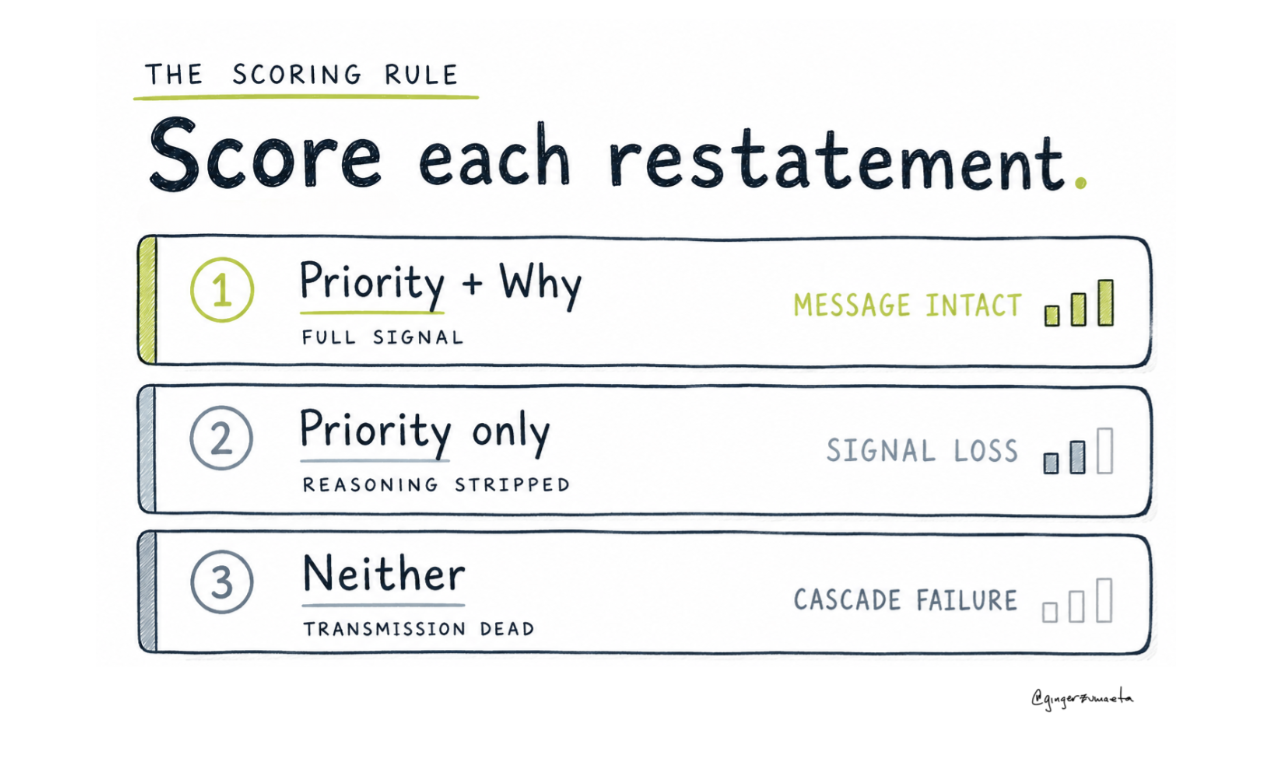
→ Score what you get back. Priority plus the why means it made the trip. Priority only means signal loss. Neither means the cascade is dead, and has been for a while.
Run it this week. It's quick, and you can do it in an email.
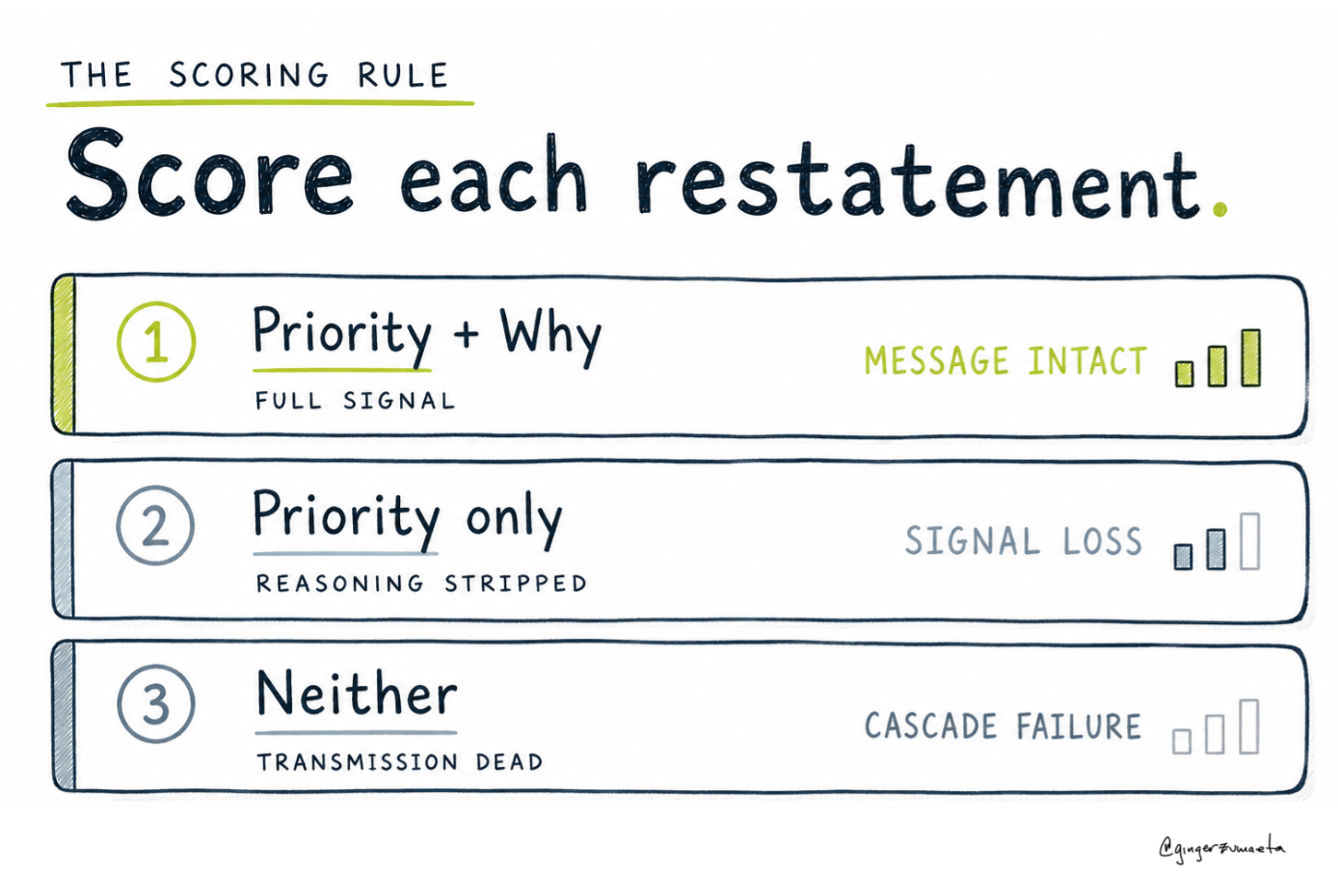
Remember you're scoring the line, not the people standing in it.
Bartlett's participants weren't careless or dumb. They were doing the ordinary human thing with a message they had no way to hold onto. So are yours.
If the "why" doesn't survive to the front line, your problem was never buy-in. It was transmission. Fix the line, and the message survives the trip. That's the work. Get in touch if you want help fixing yours.


